
Photography Tips

Photography Tip - Slow your photography down

The fastest way to get better at photography is to slow downOne of the fastest ways to improve your photography is to slow down.  I have taught hundreds of people 1-on-1 in the Tampa Bay area and often I see an unnecessary sense of urgency in trying to get a photo among people new to DSLR photography.  It is true, when I am on a job shooting, I defnitely have a sense of urgency to produce in a timely manner, but this is not the case for someone out learning photography.  There is no pressure to produce for a client, and certainly no money on the line when you press the shutter!  So why not slow down and take the pressure off of yourself?  

There are a number of ways to slow down your photography.  One way is to use a tripod.  Attaching your camera to three long legs, having to carry that larger system around, and most significantly being able to set the camera on a stable structure so you do not have to support the weight of it while shooting, all naturally slows things down.  Shooting with a tripod is very relaxing.  You can frame the shot exactly how you want adjusting the tripod head.  You can stop and think as the physical burden of holding the often heavy-ish DSLR and lens is removed.  Picking up, moving, and re-setting up a tripod takes time that you can use to really think about what you would like to photograph next.  

Another way to slow down your photography is to give yourself a shot limit.  When I got my first DSLR in 2008, I took a lot of shots, but at least I was grinding through self-teaching myself photography.  However, even after establishing my 5-step system for shooting in manual mode, I would go to a park or some place and come back with 300+ shots.  That is a lot of shooting when not on a paying job!  There is no way I could have really thought out each of those shots.  So I recommend giving yourself a shot limit.  The next time you go to a park, pretend it's like the film days and give yourself only 24 presses of the shutter, or 36, just choose something less than 50.  Mistakes count as one of those shots.  When thinking of making a photograph you will start to develop a more critical eye and decide is this really something I want to shoot?  What is the subject matter?  What is the story this photograph will tell?

Slowing your photography down by using a tripod and/or giving yourself a shot limit will allow you to answer those questions.  You will also have far fewer shots to go through to find the gems you want to edit and keep.  Try slowing down your photography as you learn and even after you have become an accomplished shooter.  Did you come back home with a higher number of keeper images?
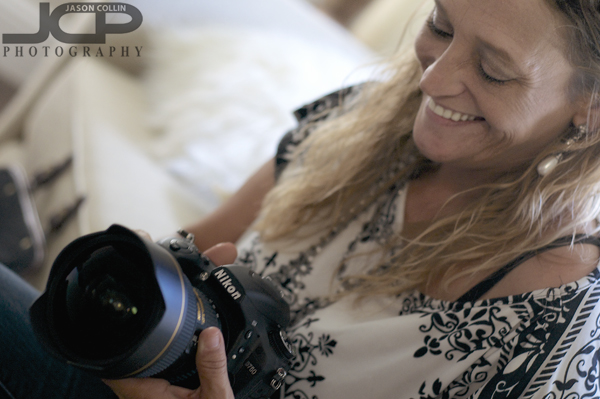
Nikon D750 Real Estate Photography Lesson in Tampa Florida with Debbi

Debbi with her brand new Nikon D750 during our 1-on-1 commercial real estate photography lesson in Tampa FloridaI often get asked by photography students, what photography gear should I buy next?  My first question back to them is, what is your budget?  When Debbi called me she said she needed everything starting with the camera and she wanted to be able to make shots of her listings for her real estate business.  I asked what the budget was first as I always do, except this time the reply was a little bit different as she said basically any budget is ok!  Well, this meant I could recommend Nikon's newest full frame DSLR, the Nikon D750 along with its tried and true Nikkor 14-24mm f/2.8G lens and my preferred Induro brand carbon fiber tripod.  Now that is a camera bag full of gear one can grow into!

This was my first time to gets hands on with the Nikon D750 and I was totally impressed.  It was hard for me to hand it back to Debbi, I wanted it to be mine!  After showing Debbi how to use my 5-step process for getting a well exposed and sharp shot in any shooting conditions, without taking the time to setup her new tripod, I just tried some very high ISO handheld shots of the rooms in the listing of hers we were in.  I was blown away by the shots I could make at ISO 3200 and higher of the rooms of the house with the Nikon D750 and the Nikkor 14-24mm lens just hand holding it.  Like really blown away.  Even shooting at the largest aperture of f/2.8 and ISO 3200 the results were startingly good in terms of lack of noise and depth of field.  For the next lesson we will actually put the D750 on a tripod and I cannot wait to see ISO 100 results!

1-on-1 DSLR Photography Lesson in commercial studio in St Petersburg Florida with Marquita

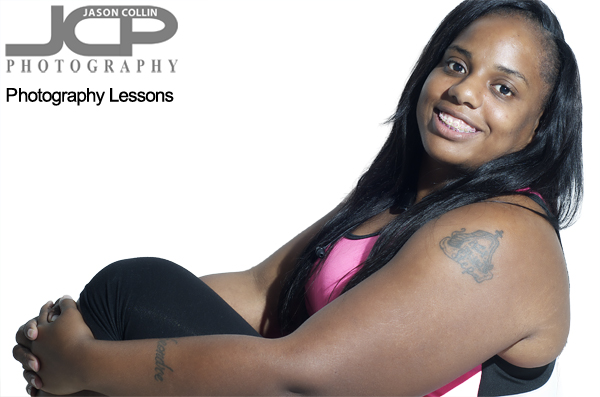
Marquita as the model during her commercial photography lesson in her own photography studio!I met Marquita for a second 1-on-1 commercial photography lesson yesterday, this time at her photography studio in the artisitc Grand Central district of St. Petersburg.  She had been practicing since we first met a few weeks ago in Curtis Hixon Park and was having some white balance issues shooting on a white background using her studio light setup.  Even though she was shooting in RAW using auto white balance, the images coming out of the camera were looking warm, and thus skin tones did not look natural, etc.  To solve this problem I showed her how to set a custom white balance on her Canon T2i which was thankfully not too difficult to figure out just by looking in the menus.  Sure enough, once she used the new custom white balance, her photographs came out looking true to color straight from the camera, not post-processing white balance adjustments needed.  

She also wanted her white background to look more white, such that it was invisible.  I put one of her studio lights directly on the background to essentially blow it out, and that combined with the custom white balance made the subject appear to be on a pure white background, again no post-processing editing needed to fix.  

We concluded the lesson by seeing what just one speedlight off camera with a reflector can do (see the above portrait of Marquita).  Marquita will be investing in a better speedlight for her event photography work, which she can also use in her studio too.  

For the next lesson we will tackle Photoshop and how to add any color background to a subject shot on her white studio background!

For party planning services, visit Marquita's website.

Canon T2i 1-on-1 DSLR Photography Lesson at Curtis Hixon Park Tampa Florida with Marquita

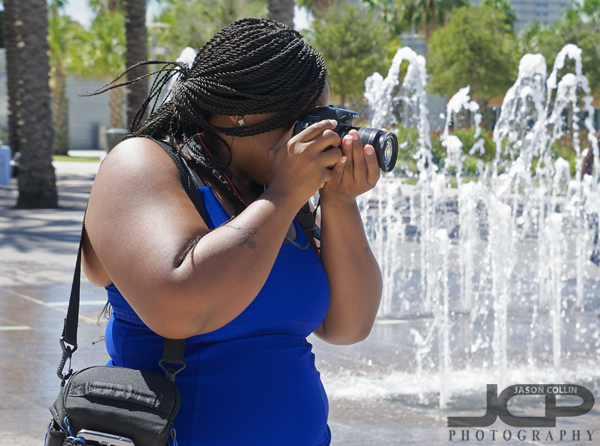
Among the fountains in Curtis Hixon Park Tampa Florida Markita learns how to shoot in manual mode with her Canon T2i during our 1-on-1 DSLR photography lessonMarquita has a party planning business (website) and wanted to be able to make her own high quality photographs for marketing and promotional purposes.  She met me one morning in Curtis Hixon Park in downtown Tampa with her Canon T2i and I began showing her how to shoot in manual mode and really take control over the results of her photographs with regard to exposure, depth of field and composition.  Marquita was a fast learner and soon was able to change all five of the necessary settings for shooting in manual mode.  

The last thing we practiced during our 1-on-1 DSLR photography lesson was a little motion blur shooting.  Marquita really liked this effect achieved by using a slow shutter speed and moving the camera while pressing the shutter to freeze the subject but blur the background to imply motion.  

Marquita has already sent practice shots of her party supplies and is applying what she learned during the photography lesson to her event party business and is thus on her way to having her new photography skills make money for her.  I look forward to meeting her again soon at her studio in St. Petersburg to learn product photography more specifically using lights and photography backgrounds, etc.

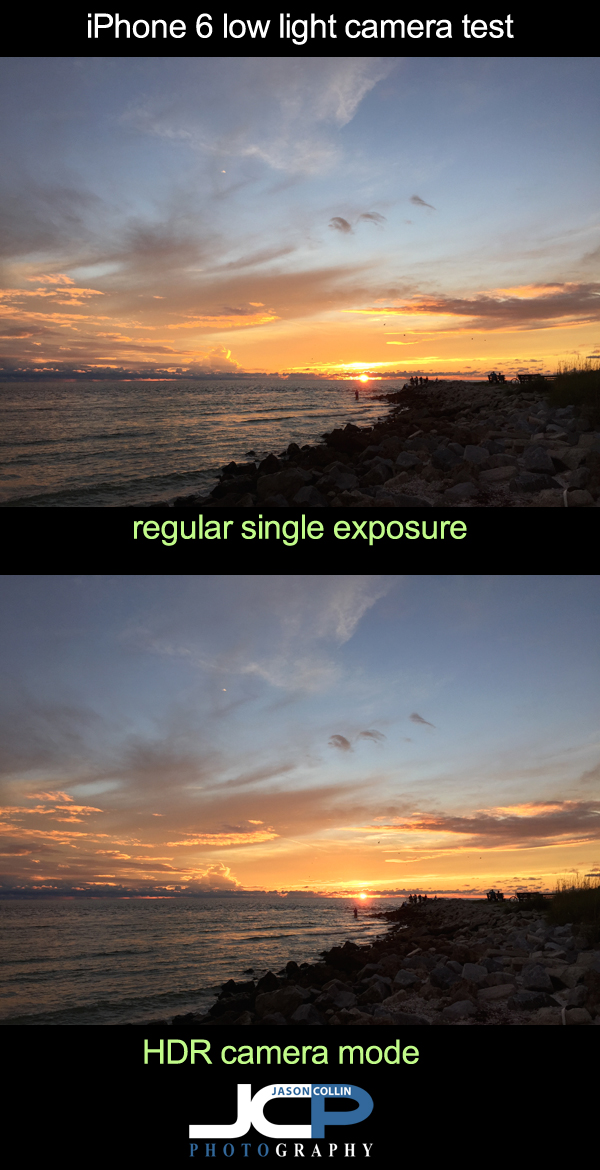
iPhone 6 first HDR sunset photograph example Pass-A-Grille Beach Florida

The iPhone makes for a great always with you photography device.  The camera in each successive iPhone model is supposed to be markedly better than the previous one.  Having pre-ordered and received an iPhone 6 on launch day, I was excited to see how much better its camera (two generations newer than my iPhone 5) was.  I was at Pass-A-Grille Beach at the southern tip of St. Petersburg and was treated to a great sunset view.  I made one photograph using the regular single exposure mode in the standard Phone app and then another photo right after using HDR mode.  Sunsets are great for HDR as the sky is often much brighter than the foreground, however, there was little difference in the single exposure and HDR iPhone 6 photographs.  The HDR one did produce a little better detail around the sun, but not enough in the rocks in the foreground.  

This was just one test of a particular photography situation, but a very common one, and overall I disappointingly did not see much difference from past iPhone 5 shots.  I will be testing out more shots using both the default Camera app and the pay Camera+ app on the iPhone 6.

Photography Tip - have a foreground element in vertical orientation photos

Photo Tip - without a foreground object this vertical orientation shot would have not enough interest as composed - made with an iPhone 5When shooting in portrait orientation (vertical shots), which I recommend to do more often than you are probably currently doing, having a foreground object really helps fill the frame with interest for the viewer.  In the above shot made with an iPhone 5, there is a salt marsh and Kiki of course as subject matter, but without the boardwalk in the foreground leading to those other subjects, it would just be empty space of little interest and probably would end up being cropped out.

So when shooting landscape type shots in portrait orientation, try and include a foreground object to add more interest to the photograph overall.  Post a link to your results in the comments below!

Nikon D5300 1-on-1 DSLR Photography Lesson in Wesley Chapel Florida with Reham

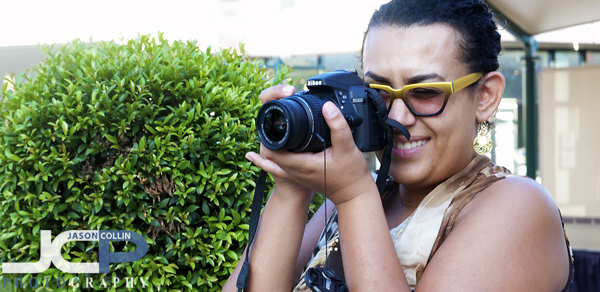
Reham practices setting the focus and recomposing with her Nikon D5300 in Wesley Chapel Florida during our 1-on-1 photography lessonOn a warm and humid Wesley Chapel Florida evening I met Reham for the second time at Shops at Wiregrass for a 1-on-1 DSLR Photography Lesson.  We first met one week earlier where I taught her my 5-step system for getting a well exposed and sharp shot in any shooting conditions.  Between now and then she practiced in a variety of settings from an outdoor restaurant to a dark bowling alley!  This practice allowed her to come to our second lesson with specific questions and specific photos to ask.  This is exactly the way to make progress in learning how to become a digital photographer, by taking what is learned during the lessons, applying it in the field, then returning with questions before learning another photography skill.  I was pleased with Reham's practice and progress in just one week!

The photography skill we focused on this time, was actually setting the focus and recomposing as I noticed she centered the subject every time in all of her practice shots.  Putting the single focus point on the subject of the photograph, pressing the shutter halfway, and keeping it pressed halfway while slightly recomposing the shot is the technique needed to prevent boring, centered subject photographs.  In particular, when photographing a person, the focus should be set upon the eyes, and then recompose from there, as I did in the portrait of Reham above.  

I will meet Reham two more times next week to get her as ready as possible to make great photographs during her trip to Paris later this month!