Photography Tips

1-on-1 Nikon D5100 DSLR Photography Lesson with Lourdes in St. Petersburg Florida

My first photography lesson with Lourdes & her Nikon D5100 spanned day & night in downtown St. Petersburg!Lourdes called me up asking about my 1-on-1 DSLR Photography Lessons telling me about how she ultimately wanted to photograph racecars!  First, she wanted to learn how to use her Nikon D5100 properly and stop just relying on auto-mode.  Since that is exactly what my photography lessons are designed to do, we got started right away after we met in downtown St. Petersburg, Florida in showing her how to change all the settings she needed to on the D5100.  With that particular Nikon in manual mode, most settings needed to be changed in menus with only aperture and shutter speed able to be changed using the thumb dial (plus another button for aperture).  Fortunately, when shooting in manual mode shutter speed is the thing most often that needs to be changed between shots so the Nikon D5100 is still fairly quick to use in the field.   

I was also able to help Lourdes become familiar with her two lenses, a Nikkor 18-55mm that came with the camera itself, and also a 75-300mm third party lens that we discovered cannot be auto-focused on the D5100 since that body itself lacks an internal focus motor and the third party lens did not have a motor in it either.  The lens could still be manually focused, but at 300mm and trying to shoot a racecar, that would not be very easy to do!

I recommended a more practical long lens (Nikkor 70-300mm VR) for Lourdes to get and will be looking forward to continuing the photography learning we started in our second lesson soon.

Have a Photography Philosophy Part 1 - make photos for yourself

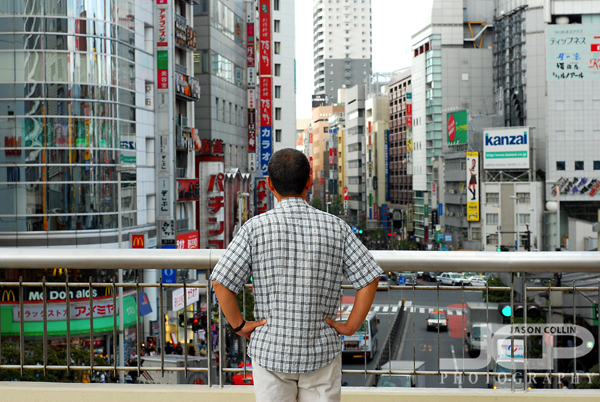
One of my all-time favorite personal photos, man contemplating Tokyo - Nikon D80 Nikkor 50mm @ f/8 ISO 400 1/250th (notice early in my DSLR photography learning I used settings I would definitely not today!)Earlier today I came up with an idea for a new photography tip series entitled, "Having a Photography Philosophy," as there are intangible things that going into photography beyond mastering exposure and even composition.  One of my personal photography philosophies has always been, even from the very start of getting more seriously into photography, was to first and foremost make photographs for myself.  It also may surprise you that I even carry this philosophy into shoots I do for clients.  The way I see it, clients have browsed my portfolios.  Therefore, they must like what they have seen to have hired me.  Thus, if I make shots that appeal to me, as I have always done in the past, then the photos I make for the client now will appeal to them as well.  Of course not every shoot allows for such creative freedom, but when I make portraits for clients or photograph cars for clients, I make shots I think look cool.  I want the final shots to also be ones I like.  This philosophy balanced with client input I believe creates very successful final images.

In my personal shooting I entirely shoot for myself first and foremost.  I go out to make shots that I like.  If someone else happens to like them, that is great, but not necessarily important to me.  After all, if you do not even like the photos you are making, how can you ever expect anyone else to like them either?  

The photo in this post is one of my all-time personal favorites.  If I could only choose one photo to remind me of what my life was like in Tokyo, it would probably be this one.  I walked by this very spot almost every day, and like the man pictured, never ceased to stop and stare at all the action, all the craziness, all the life before me.  It was also one of the very first, if not the first shot I ever took with my Nikkor 50mm f/1.8D lens that I bought in Bic Camera just to frame left.  So as you can see, this photo cannot possibly have the same amount of meaning to anyone else, which is why it is important to make photographs for yourself.

1-on-1 Nikon D7000 DSLR Bird Photography Lesson St. Petersburg Florida with Mari

Mari going all out lying on the sand to get the best perspective to photograph birds during our photography lesson in St. Petersburg Florida along the beaches near North Shore ParkThis was Mari's sixth total 1-on-1 DSLR Photography Lesson with me, and the first of a new 4-pack of lessons.  We had a very specific focus for this photography lesson:  birds.  In particular, birds along the shore both standing and flying.  I knew to get the best shots we would have to lie down flat on our stomachs, so I brought a sheet for us.  Well, the first spot we used it appeared dry but after about a minute the sheet started to get soaked through.  After that, Mari just had to be tough and lie right on the sand as seen above!

Shooting while lying down can be very comfortable, and it provides not just a very stable shooting position, but also allows for shooting at eye level to the smallest and shortest of birds.  We practiced getting sharp images by carefully setting the focus and recomposing.  Step by step Mari is improving her nature photography!

Strobist Classroom Portrait at the Morean Arts Center

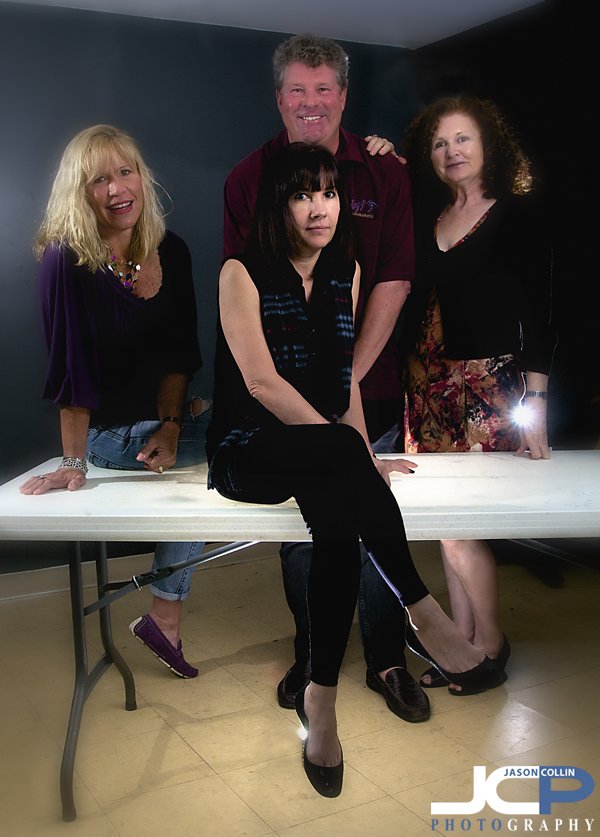
Students of my Morean Arts Center photography class. Four speedlights (all the students) were used to make this group portrait. Nikon D300 Tamron 17-50mm @ f/6.3 ISO 200 1/320th commander mode triggered flashes (1/16th power)In this morning's photography class at the Morean Arts Center I introduced my students to off camera flash.  Since everyone in the class now shoots Nikon (after one coverted from Canon after the 2nd class!) and has a Nikon Speedlight of some kind, I was able to setup everyone's Nikons (a pair of D90 & D7000) to remotely trigger everyone else's speedlights (two SB-700, SB-910, SB-600) using the Nikon Creative Lighting System via commander mode.  That meant anytime anyone pressed their shutter, all four speedlights went off!  

Well, we actually started off with just a two speedlight setup with Anne volunteering to be a great model!  We concluded the class with my suggested 4-strobe experiment.  As you can see in the shot above, one speedlight was on a chair behind everyone, another speedlight under the table, a speedlight in a 43" shoot-through umbrella in front and another speedlight on a light stand to frame left.

I hope our fun strobist experiements encourages everyone to try off camera flash portraits before our next class!

1-on-1 Canon T1i DSLR Photography Lesson in St. Petersburg Florida with Jim

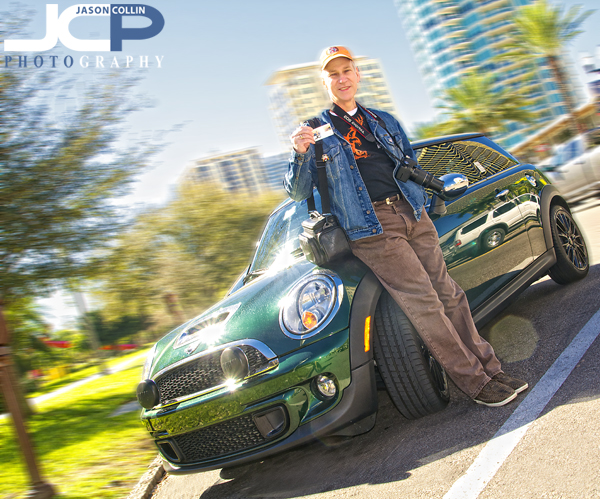
Jim with his Canon T1i flashing my business card leaning against his Mini John Cooper Works

Jim cashed in his photography lesson gift certificate he received for Christmas this past Saturday.  I met him in the usual downtown St. Petersburg Florida spot for a 1-on-1 DSLR photography lesson with his Canon T1i.  When I saw him pull up in his Mini Cooper, John Cooper Works edition, I thought it would be great to use as the background for the portrait I make of each student as a lesson bonus.  

We began the lesson with me showing Jim how to get around his Canon in manual mode, being able to adjust the 5 settings necessary to make a well exposed and sharp shot in any given shooting conditions.  From there we made our way around the beautiful downtown St. Petersburg waterfront shooting while I offered instructions simultaneously, which I believe is the best way to learn photography.  

We also talked about cars and I enjoyed hearing Jim's story about how he got to drive his friend's Ferrari!

Nikon D7000 1-on-1 DSLR Photography Lesson in St. Petersburg Florida with Anne

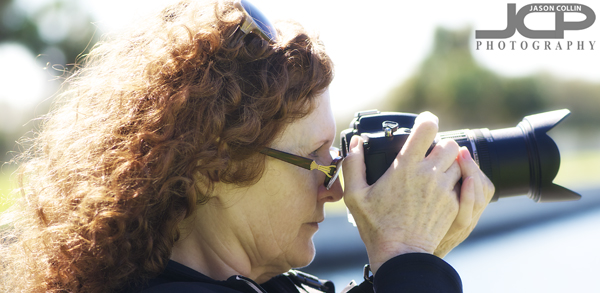
Anne with her new Nikon D7000 in Vinoy Park during our 1-on-1 photography lessonThis morning I met Anne for a 1-on-1 DSLR Photography Lesson in downtown St. Petersburg.  Currently, Anne is also taking my photography class at the Morean Arts Center.  She started the class with an older Canon DSLR, the only Canon shooter of the five students.  When her 18-55mm lens broke, and no doubt with a little suggestion by all the other Nikon shooters in the room, on my advice she invested in a Nikon D7000, a Tamron 17-50mm f/2.8 lens (I own this lens myself) and the Nikkor 70-200mm VR lens, oh and a SB-700 Speedlight too!  

Having made this ecosystem change and wanting more in-depth 1-on-1 instruction, our 2-hours this morning were focused on suring up what we had already discussed in the group lessons and helping her get more familiar with Nikon as well.  In this style of learning, Anne caught on rather fast allowing me to introduce composition tips as well.  As we made our way out to Vinoy Park, I showed Anne the benefits of having a S-curve in the frame and how to use lines in general to move the viewer's eye across a photograph.

Anne is also learning how valuable it is to take just even ten photographs a day, as per the advice I gave everyone in the Morean photo class.  The goal of that is not to make portfolio shots, but to start memorizing the layout of your gear and to make adjusting for correct exposure instinctual rather than requiring concentrated thought.  I look forward to seeing Anne's progress next Tuesday in the classroom.

Photography Tip - think of ISO like a pair of sunglasses

Over the past few months I have started to describe ISO to my photography students like a pair of sunglasses.  You have sunlight hitting your eyes.  When wearing sunglasses your eyes feel all nice and comfortable even with all that sunlight.  However, if you take off your sunglasses, the same amount of light is hitting your eyes, except now it hurts and you squint.  There is a cost to taking off your sunglasses.  

It is the same thing with ISO.  There is a certain amout of light hitting your DSLR camera's sensor.  If you increase the ISO setting, the same amount of light will hit the sensor, except now the camera's sensor with a higher ISO is more sensitive to that same amount of light.  This is just like your eyes getting more sensitive without sunglasses.  The tradeoff with no sunglasses is squinting.  The tradeoff with high ISO is introducing noise, grain and artifacting into the photograph.  

This is why I usually only increase ISO last when trying to get the correct exposure.  Most of the time I will use the largest aperture possible with the slowest shutter speed possible.  Once I hit those limits, only then do I start to increase ISO because I want to maximize image quality as much as possible.