Photography Tips

Strobist DSLR Photography Lesson with Steve

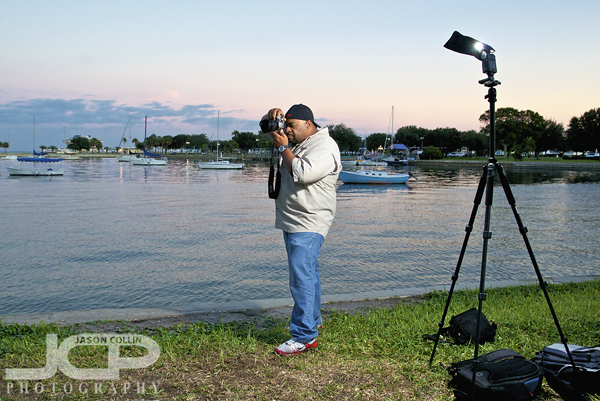
Our setup for Steve's strobist off camera flash DSLR photography lesson right on the beautiful St. Petersburg waterfront

Steve took his second DSLR Photography Lesson in as many weeks.  This time we focused entirely on off camera flash, or simply known as strobist.  This is currently my favorite thing about photography so it was really fun for me also to teach a lesson entirely on getting the flash of the camera.  

Steve has a Canon XT and a third party flash.  We used my Yongnuo remote flash triggers and my tripod as a light stand.  I also put my HONL snoot onto his flash to help diffuse the light.  

We had a number of laughs using ourselves as the models for the lesson.  Perhaps the biggest smile of all came when Steve began to realize how awesome, and how relatively easy, off camera flash photography is.  It is always very satisfying to share photography knowledge with such tangible results.

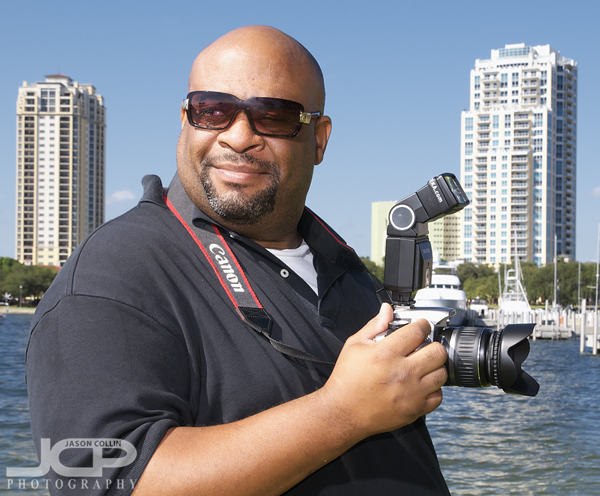
I made this portrait of Steve using my Nikon D300 and his 3rd party flash (see setup above)
  • Reserve your own 1-on-1 DSLR Photography Lesson with Jason today!
  • Learn more about the lessons
  • Browse past lessons with all of my students 
  • DSLR Photography Lesson with Steve & his Canon XT

    Steve recently stepped up from the point & shoot world to the DSLR world with his Canon XTWhen I first decided to offer DSLR photography lessons, I was thinking, "lots of people are buying DSLR cameras, but maybe realizing they are nowhere near as easy to use as their old point & shoot digital cameras.  There must be a market for people wanting to take lessons."  Steve fit exactly into that category.  He recently graduated from his point and shoot to a Canon XT with a pair of lenses and an external flash.  Like many people new to DSLRs, he was mostly using auto mode and not happy with the results.  The lessons I offer are designed to directly address that issue and get a person off auto mode forever (hopefully) after just a single 2-hour lesson.

    It is not often I meet someone who can talk about Rhode Island, but besides our photography conversation, we also talked about the Ocean State, which I welcomed.  Steve reminded me of places I had not thought of in over 20 years, like good old Rocky Point Park, which he said is no longer open.  Maybe it will turn into a haikyo?

    As is often the case, Steve was surprised and impressed with what one can do with an external flash in broad daylight.  We already have our next lesson scheduled for later this week! 

  • Reserve your own 1-on-1 DSLR Photography Lesson with Jason today!
  • Learn more about the lessons
  • Browse past lessons with all of my students 
  • DSLR Photography Lesson with Betty & her Canon T1i

    Betty showing good camera holding technique and that it is possible to wear sunglasses at the same time!I met Betty at the usual downtown St. Petersburg spot for our first DSLR Photography Lesson together.  She has a Canon T1i, a DSLR I have gotten quite familiar with due to numerous students having that specific camera.  We went to many of the same spots I take first-time students too, but we also had a chance to do a little event photography practice as it was the day before Halloween and something was happening in the Straub Park areas.  We put both of her lenses to use throughout the lesson, including teaching good lens changing technique.

    Betty seemed to absorb all we covered during the 2-hour lesson very well and I am looking forward to seeing her improved photographs and our next lesson! 

  • Reserve your own 1-on-1 DSLR Photography Lesson with Jason today!
  • Learn more about the lessons
  • Browse past lessons with all of my students 
  • Photography Tip - always close your camera bag

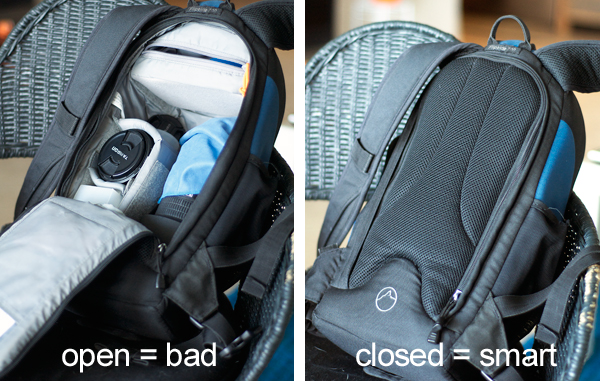
    This is a true story -- I was walking in downtown St. Petersburg toward The Pier with a student while we were having a lesson.  A woman with a Canon DSLR and large camera bag walked past us.  Ten seconds later we heard a crash and a scream.  The woman had not closed her camera bag all the way and some of her gear fell onto the sidewalk.  Even before this I was already obsessed with closing my camera bag immediately after taking out what I needed, even if I knew I would be going right back into my bag only a minute later.  It is a pain in the neck no doubt to zip and unzip and zip and unzip all the time, but that minor annoyance is nothing compared to the ill feeling that woman with the spilled gear might have felt.  

    Even if your camera bag is not in motion while left open, I still think it's dangerous.  In the photo above my camera bag is set in a chair.  I made sure it was firmly in the chair.  However, I have set countless things firmly in chairs, on countertops, totally sure there is no way those things could fall over, yet many have.  At least if my bag falls out of the chair closed, the ample, stiff padding of my Lowepro bag will protect it.  

    What if you see something interesting and you just grab your bag and head towards it?  If it's open you will maybe risk spilling stuff just grabbing it, or at the least you'll have to take a few seconds to close it up then go, which you may know in photography, a few seconds can make all the difference between getting a shot and getting nothing.

    Therefore, I recommend becoming obsessive about closing your camera bag right back up.

    Digital Photograph Editing Lesson with Eric

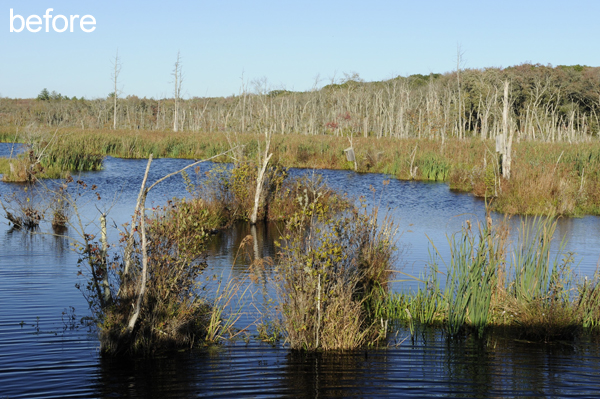
    A New England wetlands scene edited using Aperture 3 - photo by Eric used with permissionFor Eric's second DSLR photography lesson (first), he brought some photos of his recent visit to various New England areas with him on his laptop.  We found a spot at an outdoor downtown St. Petersburg cafe and starting going through his shots made using his Nikon D300s.  The one featured above was taken when Eric hopped off his bike (bicycle) because he wanted to remember the beautiful scenery he was riding through.  Upon first look at the shot, I liked the sine wave shape of the treeline, but thought the foreground was dominating the image too much and not the best feature to focus one's eye on.

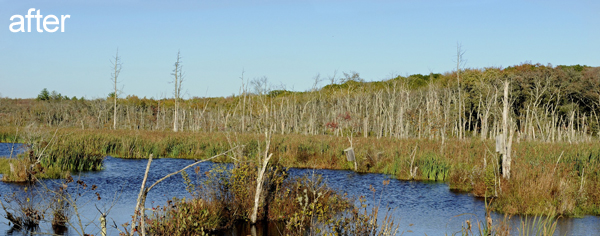
    So we began by making the panoramic crop you see above, that eliminated many of the distracting foreground elements, and also made a shot that was not taken at a wide angle appear to be of a much wider landscape.  Adjusting various filters added some contrast and tones to the marsh grass.  Painting with the polarizing brush in Aperture 3 brought back some blue to the sky.  

    This is another example of why I highly suggest that one learn how to shoot well and how to edit well simultaneously.  Eric cannot easily return to that marshland to frame the shot in a different way, but with editing skills he can improve a shot and make it look more like what he initially envisioned.

    For more on learning editing and shooting simultaneously check out this blog post featuring my own photo example.

    I look forward to seeing how Eric puts these editing skills to use in future shots. 

  • Reserve your own 1-on-1 DSLR Photography Lesson with Jason today!
  • Learn more about the lessons
  • Browse past lessons with all of my students 
  • DSLR Photography Lesson with Davina and her new Pentax K-R

    Davina and her brand new Pentax K-R with beautiful St. Petersburg Florida at twilight in the background

    Davina received a great present from her husband for their anniversary, a DSLR camera!  It was my first time to see the new Pentax K-R and was fairly impressed with the number of buttons on the body, including dedicated WB and ISO controls.  I had no trouble finding and changing any of the four basic settings (aperture, ISO, WB, focus) I start out teaching in a first DSLR photography lesson.  I cannot say this for all the DSLRs I have seen in the many lessons I have taught.  

    We had great weather for our Friday evening lesson and made our way toward the downtown St. Petersburg waterfront to start to learn how a photographer controls the background of his/her images.  There are two things that can really make a photograph stand out from others of similar subject matter:  1.)  background  2.)  light  We focused on background first by photographing the top of a fence post (imagining it was a cool 1950s Chevy hood emblem) the best way, which was to blur the background by using a large aperture and a longer focal length as well as filling the frame with the subject matter.  Basically, we did not want the background to be a distraction, so I showed Davina how to set her Pentax to isolate the subject, and therefore leave no doubt to what it was she made a photo of.  

    In between locations I enjoyed talking to Davina about the benefits of living in Florida and what it is really like in Utah (not just red rock desert!).  I look forward to our next lesson and seeing more of what the Pentax K-R can do. 

  • Reserve your own 1-on-1 DSLR Photography Lesson with Jason today!
  • Learn more about the lessons
  • Browse past lessons with all of my students 
  • Photography Tip - recharge your batteries, right away!

    Eneloop rechargeable batteries hold their charge well, so I do not worry about leaving them in my camera bag for weeks.So you have a spare battery for your DSLR camera and even an extra set of batteries for your external flash.  That's great!  Are both sets of batteries fully charged right now?  Often the last thing a photographer wants to do after shooting a 4-hour event or an 8-hour wedding when getting home is taking out the old battery charger and loading it up with drained batteries.  Yet recharging your dead batteries right away is a photography tip I highly recommend.  There are several reasons for this: 

    • What if you suddenly get a big job the next day? 

    This happened to me just last month.  A contact at the Treasure Island Yacht & Tennis Club called me up saying there was an event going on right now that they wanted a photographer for.  At the time I was on the other side of Tampa Bay, an hour away, and did not have any of my gear with me.  I was still able to take the job though because there was still time for me to cruise across the Howard Franklin (traffic free at that time) grab my camera bag, and head to the yacht club.  If all my batteries were not already charged, I would have had to of either shot conservatively over the 3-hour job (totally not ideal) or further delayed my arrival on the job site by stopping to buy some AA batteries at CVS.   

    • One less thing to worry about before shooting an all day wedding 

    In the days before shooting a long wedding (6 to 10 hours) there are a lot of things a wedding photographer has to make final checks on.  Therefore, I do not want to have recharging all my batteries on that list as well.   

    • What if the job goes long? 

    Maybe the event planner underestimates the time they needed a photographer for.  You were told it would just be an hour long job.  Only one set of batteries was charged, but you knew that would be more than enough for just an hour of shooting.  Then they want you to stay on for another two hours.  It would be terrible to have to say no because you do not have the batteries to do it, or have to leave the site to get more batteries, assuming the piece of gear you need batteries for does not use proprietary ones. 

    • I'm not a pro photographer, should I be so strict about keeping my batteries charged? 

    Yes!  Just like a wedding photographer the day before a wedding, a parent on the day before a big family day trip has a mile long checklist of things to get ready.  Recharging batteries could easily get forgotten or not remembered in time.  It is extremely wise policy for the hobbyist shooter to adopt as many pro photographer habits as possible.  This is from personal experience.  I used to not be as serious when just photographing my family and friends on day trips, etc, but then there were just too many "forgot the memory card," "left bracketing on," mistakes so I prepared to photograph those fun, personal events just like (almost) I would a paid professional event.