Photography Tip - Intro to the Histogram

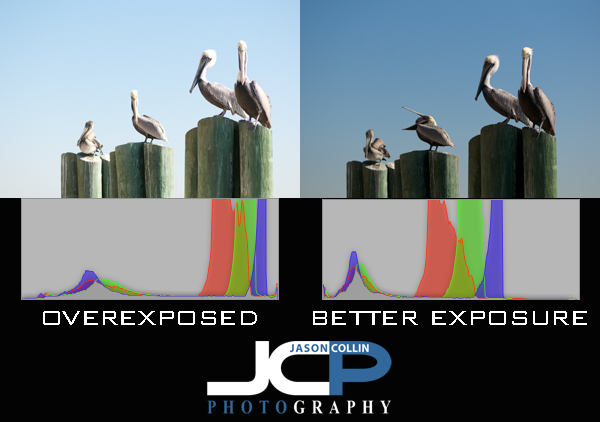
The histogram is a very useful way of checking and confirming exposure, especially out in the field.  It may just look like a bunch of strange squigly lines or a series of jagged mountains, but the histogram tells you exactly what your photograph really looks like in terms of exposure and color.  Since it is often hard to see the camera's review screen in direct sunlight to judge exposure, the histogram for a photographer is like a pilot flying an airplane by using only instruments.  You do not even need to see the photograph to tell if it is a dark image, a bright one, or even a very colorful one.  Essentially, the histogram looks like a rectangular box representing 256 shades of gray or individual colors, or all of them (see the histograms above showing grayscale and RGB color as Aperture 3 represents the histogram).  Black is on the left edge and white is on the right edge.  The more data to the left, means the darker an image is, and potentially underexposed.  The more date to the right means a brighter image, and possibly an overexposed ones.

It is usually best to try and get as much of the data in the center forming a nice mountain, with no spikes at either the far left or far right edges.  In the samples above, the left histogram has most of its data on the right side, indicating the photo is a bright exposure, as can be confirmed by looking at the photo itself.  The histogram on the right is much more balanced and a more even exposure, as seen in the photo showing a bluer sky and better whites in the pelicans' heads.
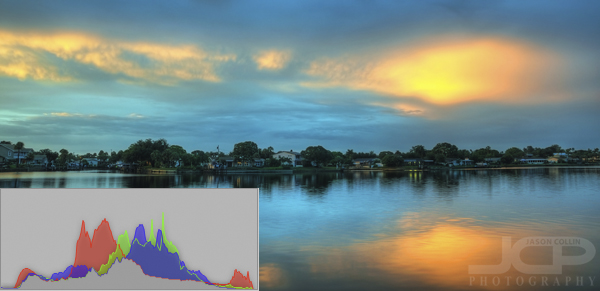
The above image of Smacks Bayou (as seen from just off my back patio) has a histogram that is about as ideal as it can get.  The majority of the data for grayscale and RGB color is in the middle-center and there is a lot of range in those colors.  The taller the peaks, the more of that particular color or shade of gray.  There are also no spikes at either far edge of the histogram.

Creative Business Headshot in St. Petersburg Florida home studio with Clark

A more creative style of business headshot, Mad Men was an influence! - Nikon D300 Nikkor 80-200mm @ f/7.1 ISO 200 1/160th - Strobist: SB-800 @ 1/4 power in 43" brolly to frame rightThis afternoon Clark came to my home studio in St. Petersburg, Florida for a business headshot.  We had been in contact the day before and he sent me a few samples of headshot styles he liked.  He was definitely open to something other than the bright, straight on traditional business headshot.  Actually, the above shot was my favorite from the headshot session and not one of Clark's choices, but I still gave it to him as a free bonus anyway!  For me, I liked the S-curve of his head tilt on down to the slight bend of his tie.  I used selective editing to make the background essentially go black then cropped to create the final look and feel of the image.  This could very well turn out to be one of my five favorite shots of 2013!

Another more dramatically lit style business headshot - Nikon D300 Nikkor 80-200mm @ f/10 ISO 200 1/160th - Strobist: SB-800 @ 1/4 power in 43" brolly to immediate frame rightAgain, using just one speedlight off camera in order to create more defining shadows in the headshot, the above image cropped tightly purposefully below the top of the head, is a more stylized business headshot.  This is just one of many types possible that I offer both here in my home studio and also possible right in your office or home location.  

It took Clark and I a little longer than usual to create these headshot images, but I was glad to as I am always happy when I can produce new work and when a client is willing to experiment a little along with me.  Thanks Clark!

UPDATE from Clark:

Shortly after getting my professional picture from Jason, I posted the following message in ~50 LinkedIn groups:

I am a LION growing my network while seeking employment in the Tampa Bay area - Connect with me at www.linkedin.com/in/clarkfinnical - While
you’re there check out my profile. :)

In a matter of days my connections have grown from 800 to 1500.  I believe the professional picture that Jason created played a major part in that success. -- Clark


1-on-1 Nikon D5100 DSLR Photography Lesson with Lourdes in St. Petersburg Florida

My first photography lesson with Lourdes & her Nikon D5100 spanned day & night in downtown St. Petersburg!Lourdes called me up asking about my 1-on-1 DSLR Photography Lessons telling me about how she ultimately wanted to photograph racecars!  First, she wanted to learn how to use her Nikon D5100 properly and stop just relying on auto-mode.  Since that is exactly what my photography lessons are designed to do, we got started right away after we met in downtown St. Petersburg, Florida in showing her how to change all the settings she needed to on the D5100.  With that particular Nikon in manual mode, most settings needed to be changed in menus with only aperture and shutter speed able to be changed using the thumb dial (plus another button for aperture).  Fortunately, when shooting in manual mode shutter speed is the thing most often that needs to be changed between shots so the Nikon D5100 is still fairly quick to use in the field.   

I was also able to help Lourdes become familiar with her two lenses, a Nikkor 18-55mm that came with the camera itself, and also a 75-300mm third party lens that we discovered cannot be auto-focused on the D5100 since that body itself lacks an internal focus motor and the third party lens did not have a motor in it either.  The lens could still be manually focused, but at 300mm and trying to shoot a racecar, that would not be very easy to do!

I recommended a more practical long lens (Nikkor 70-300mm VR) for Lourdes to get and will be looking forward to continuing the photography learning we started in our second lesson soon.

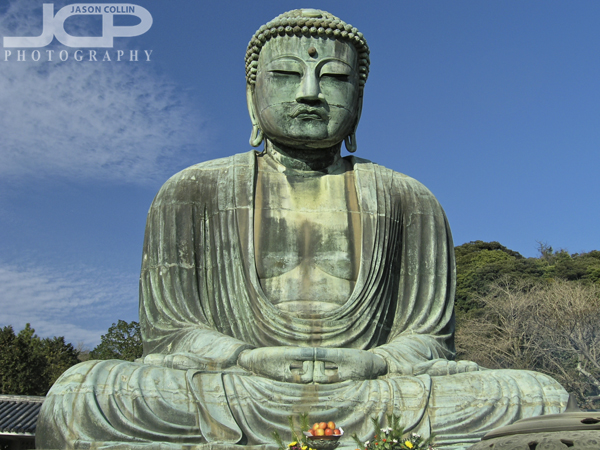
Daibutsu the Great Buddha of Kamakura Japan

In Kamakura Japan there sits Daibutsu (Great Buddha) - Olympus 5060 digital cameraNine years ago I visited Kamakura, Japan for the first time the day after New Year's.  It was just a train ride for me from my apartment in Tokyo, but it felt like traveling back in time to a different era.  Kamakura is home to many ancient things, including Daibutsu, The Great Buddha, a statue some 44 feet tall.  You may be surprised, as I was, that the statue is hollow and you can go inside and climb some stairs to look out the eyes yourself!

Daibutsu of Kamakura Japan sits some 44 feet tall - Olympus 5060 digital cameraThese photographs were made long before I entered the DSLR world, and in fact to my knowledge there were no consumer DSLRs even available.  I had a 5 megapixel Olympus 5060 digital camera.  I do recall shooting from a tripod on this day.  The biggest holidays of the year for Japanese are on and around New Year's, so it was not surprising to see many visitors there on January 2, 2004.  

Buddha statues of all sizes are offered fruit on a daily basis - Olympus 5060 digital cameraStatues of Buddha all over Asia almost always have fruit as an offering in front of them.  I thought the scale of the large statue and small fruit was amusing in this composition as I imagined Daibutsu trying to pick up one of those small apples with his large hands.

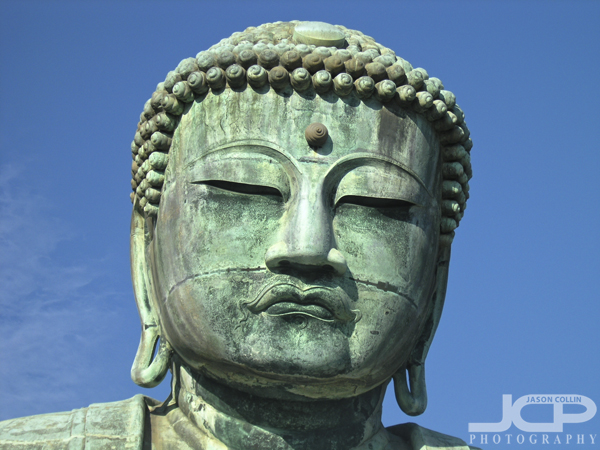
The eyes of Daibutsu are 1m wide - Olympus 5060 digital cameraKamakura is a must see location for anyone visiting Japan.  Besides the statue of Daibutsu, there are many other ancient temples each with secret places to explore.  

Have a Photography Philosophy Part 1 - make photos for yourself

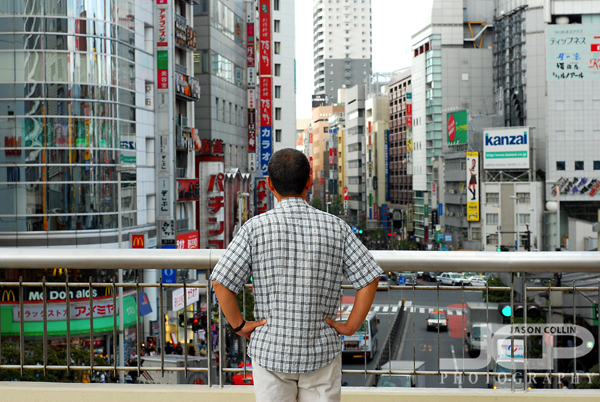
One of my all-time favorite personal photos, man contemplating Tokyo - Nikon D80 Nikkor 50mm @ f/8 ISO 400 1/250th (notice early in my DSLR photography learning I used settings I would definitely not today!)Earlier today I came up with an idea for a new photography tip series entitled, "Having a Photography Philosophy," as there are intangible things that going into photography beyond mastering exposure and even composition.  One of my personal photography philosophies has always been, even from the very start of getting more seriously into photography, was to first and foremost make photographs for myself.  It also may surprise you that I even carry this philosophy into shoots I do for clients.  The way I see it, clients have browsed my portfolios.  Therefore, they must like what they have seen to have hired me.  Thus, if I make shots that appeal to me, as I have always done in the past, then the photos I make for the client now will appeal to them as well.  Of course not every shoot allows for such creative freedom, but when I make portraits for clients or photograph cars for clients, I make shots I think look cool.  I want the final shots to also be ones I like.  This philosophy balanced with client input I believe creates very successful final images.

In my personal shooting I entirely shoot for myself first and foremost.  I go out to make shots that I like.  If someone else happens to like them, that is great, but not necessarily important to me.  After all, if you do not even like the photos you are making, how can you ever expect anyone else to like them either?  

The photo in this post is one of my all-time personal favorites.  If I could only choose one photo to remind me of what my life was like in Tokyo, it would probably be this one.  I walked by this very spot almost every day, and like the man pictured, never ceased to stop and stare at all the action, all the craziness, all the life before me.  It was also one of the very first, if not the first shot I ever took with my Nikkor 50mm f/1.8D lens that I bought in Bic Camera just to frame left.  So as you can see, this photo cannot possibly have the same amount of meaning to anyone else, which is why it is important to make photographs for yourself.

Black Skimmer bird St. Petersburg Florida North Shore Beach area

A black skimmer bird in St. Petersburg, Florida nature photography - Nikon D300 Nikkor 80-200mm @ f/5.6 ISO 200 1/800thThis black skimmer was enjoying the late afternoon sunshine on a small beach in the North Shore Park area of St. Petersburg, Florida.  I had to get down on the sand to get to the bird's eye level for this composition.  These birds get their name from skimming their beaks over the surface of the water in search of food.  Unfortunately, this bird and all her friends must have already eaten dinner because they were just standing around and I could not get any cool action shots of them skimming.  Such is the nature of nature photography!

1-on-1 Nikon D7000 DSLR Bird Photography Lesson St. Petersburg Florida with Mari

Mari going all out lying on the sand to get the best perspective to photograph birds during our photography lesson in St. Petersburg Florida along the beaches near North Shore ParkThis was Mari's sixth total 1-on-1 DSLR Photography Lesson with me, and the first of a new 4-pack of lessons.  We had a very specific focus for this photography lesson:  birds.  In particular, birds along the shore both standing and flying.  I knew to get the best shots we would have to lie down flat on our stomachs, so I brought a sheet for us.  Well, the first spot we used it appeared dry but after about a minute the sheet started to get soaked through.  After that, Mari just had to be tough and lie right on the sand as seen above!

Shooting while lying down can be very comfortable, and it provides not just a very stable shooting position, but also allows for shooting at eye level to the smallest and shortest of birds.  We practiced getting sharp images by carefully setting the focus and recomposing.  Step by step Mari is improving her nature photography!