Photography Tips

DSLR Photography Lesson with Davina and her new Pentax K-R

Davina and her brand new Pentax K-R with beautiful St. Petersburg Florida at twilight in the background

Davina received a great present from her husband for their anniversary, a DSLR camera!  It was my first time to see the new Pentax K-R and was fairly impressed with the number of buttons on the body, including dedicated WB and ISO controls.  I had no trouble finding and changing any of the four basic settings (aperture, ISO, WB, focus) I start out teaching in a first DSLR photography lesson.  I cannot say this for all the DSLRs I have seen in the many lessons I have taught.  

We had great weather for our Friday evening lesson and made our way toward the downtown St. Petersburg waterfront to start to learn how a photographer controls the background of his/her images.  There are two things that can really make a photograph stand out from others of similar subject matter:  1.)  background  2.)  light  We focused on background first by photographing the top of a fence post (imagining it was a cool 1950s Chevy hood emblem) the best way, which was to blur the background by using a large aperture and a longer focal length as well as filling the frame with the subject matter.  Basically, we did not want the background to be a distraction, so I showed Davina how to set her Pentax to isolate the subject, and therefore leave no doubt to what it was she made a photo of.  

In between locations I enjoyed talking to Davina about the benefits of living in Florida and what it is really like in Utah (not just red rock desert!).  I look forward to our next lesson and seeing more of what the Pentax K-R can do. 

  • Reserve your own 1-on-1 DSLR Photography Lesson with Jason today!
  • Learn more about the lessons
  • Browse past lessons with all of my students 
  • Photography Tip - recharge your batteries, right away!

    Eneloop rechargeable batteries hold their charge well, so I do not worry about leaving them in my camera bag for weeks.So you have a spare battery for your DSLR camera and even an extra set of batteries for your external flash.  That's great!  Are both sets of batteries fully charged right now?  Often the last thing a photographer wants to do after shooting a 4-hour event or an 8-hour wedding when getting home is taking out the old battery charger and loading it up with drained batteries.  Yet recharging your dead batteries right away is a photography tip I highly recommend.  There are several reasons for this: 

    • What if you suddenly get a big job the next day? 

    This happened to me just last month.  A contact at the Treasure Island Yacht & Tennis Club called me up saying there was an event going on right now that they wanted a photographer for.  At the time I was on the other side of Tampa Bay, an hour away, and did not have any of my gear with me.  I was still able to take the job though because there was still time for me to cruise across the Howard Franklin (traffic free at that time) grab my camera bag, and head to the yacht club.  If all my batteries were not already charged, I would have had to of either shot conservatively over the 3-hour job (totally not ideal) or further delayed my arrival on the job site by stopping to buy some AA batteries at CVS.   

    • One less thing to worry about before shooting an all day wedding 

    In the days before shooting a long wedding (6 to 10 hours) there are a lot of things a wedding photographer has to make final checks on.  Therefore, I do not want to have recharging all my batteries on that list as well.   

    • What if the job goes long? 

    Maybe the event planner underestimates the time they needed a photographer for.  You were told it would just be an hour long job.  Only one set of batteries was charged, but you knew that would be more than enough for just an hour of shooting.  Then they want you to stay on for another two hours.  It would be terrible to have to say no because you do not have the batteries to do it, or have to leave the site to get more batteries, assuming the piece of gear you need batteries for does not use proprietary ones. 

    • I'm not a pro photographer, should I be so strict about keeping my batteries charged? 

    Yes!  Just like a wedding photographer the day before a wedding, a parent on the day before a big family day trip has a mile long checklist of things to get ready.  Recharging batteries could easily get forgotten or not remembered in time.  It is extremely wise policy for the hobbyist shooter to adopt as many pro photographer habits as possible.  This is from personal experience.  I used to not be as serious when just photographing my family and friends on day trips, etc, but then there were just too many "forgot the memory card," "left bracketing on," mistakes so I prepared to photograph those fun, personal events just like (almost) I would a paid professional event.

    DSLR Photography Lesson #2 with Craig

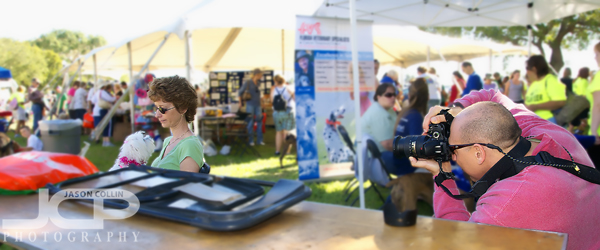
    Craig is not shy about asking if he can photograph people in public with his Nikon D60Craig and I met at the same downtown St. Petersburg location as our first lesson just a little over two week ago, only this time to my surprise a large event (SPCA 3km pet walk) was going on.  This was a bonus as Craig really likes to photograph people and is not afraid at all to ask someone if he can take their photo.  I would say he photographed at least 6 different people up close!

    Me of course, I'm shy and my street photography is done with a 80-200mm f/2.8 lens.  However, what I do not need to teach Craig in boldness, I still was able to offer him some new tips and techniques for shooting in such unpredictable event lighting without a flash.  I was able to convince him that using manual exposure mode would in fact be easier, not harder, than using aperture priority mode.  That's what I especially like to do during lessons, eliminate fear and show that DSLR photography is not super mysterious.  Well, it's a little mysterious of course, but there are answers to all questions, so no need to hold onto photographer fears (for example not shooting in RAW mode -- just get Aperture 3, import the RAWs and it processing them all automatically, you will never even know you are not working with JPGs anymore).

    Actually, at the end of the lesson we did talk about some quick editing tips as Craig brought his laptop with him and showed me some family portraits I took.  I immediately gave him the sound advice someone once gave me, "I see no portrait orientation shots.  Take portrait orientation shots."  

    The whole 2-hour lesson time passed by fast again.  Maybe next time I might meet Craig more toward his neck of the woods, Lutz! 

  • Reserve your own 1-on-1 DSLR Photography Lesson with Jason today!
  • Learn more about the lessons
  • Browse past lessons with all of my students
  • DSLR Photography Lesson with Craig & his Nikon D60

    Craig was very eager and happy to learn what his Nikon D60 is capable of beyond auto mode

    It was a beautiful mid-day in downtown St. Petersburg when I met Craig for ours first DSLR Photography Lesson together.  Craig has owned a Nikon D60 for awhile now, but like so many of my past students was mainly using auto-mode.  It gives me great pleasure to declare to students that they will never (at least should never) use auto-mode again after even just our first lesson.  I have learned from student feedback that there is a certain fear hurdle to overcome about learning to become more serious about photography.  That it seems like every shot requires adjusting a laundry list of settings.  However, that is totally not true.  In reality, given the same shooting conditions, there are relatively few settings that need to be changed at all from shot to shot.  

    Craig and I had a long Q&A session at the beginning going over settings, various scenarios, gear recommendations and some how-to's.  Once we got up and started shooting, Craig was won over with the bokeh he could produce in his shots using his Nikon D60 at f/5.6 and Nikkor 18-200mm VR lens at its full 200mm focal length.  This was not surprising, bokeh is always a crowd pleaser!

    A great egret was a willing model for us once we walked over to Vinoy Park allowing Craig to practice composing for a clean background, best exposure and fill-the-frame details.  The 2-hour lesson time went by quickly and I am sure I will be seeing Craig again soon. 

  • Reserve your own 1-on-1 DSLR Photography Lesson with Jason today!
  • Learn more about the lessons
  • Browse past lessons with all of my students 
  • DSLR Photography Lesson with Hal & his Canon T1i

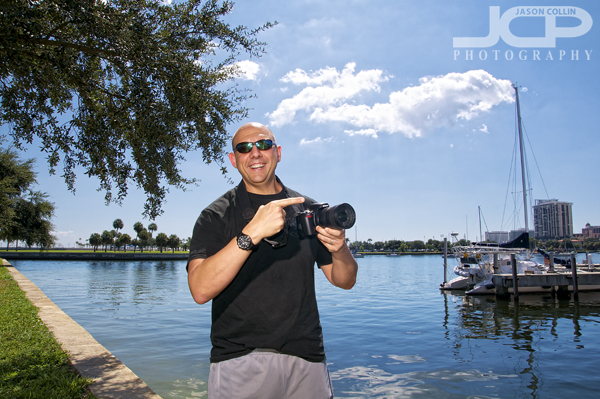
    Hal with his Canon T1i & Quantaray 18-128mm lens with downtown St. Petersburg in the background

    Just minutes after I met Hal in front of the Museum of Fine Arts in downtown St. Petersburg for our first DSLR photography lesson, it started raining.  We were still on the steps of the museum going over some introductory things about his Canon T1i so we took refuge under the long open corridor that runs along the front face of the museum.  I knew being stuck in this spot was not so bad because in February a photography group I was with made good use of it (2nd photo).

    While the rain continued to fall Hal and I continued to go through the basic settings that need to be adjusted for any kind of shot, i.e. aperture, ISO, white balance and focus mode.  Fortunately, the rain did let up and we were free to roam to Vinoy Park to practice landscape shots.  The combination of the onset of the golden hour and the post-storm skies made for an above average backdrop to both The Pier and the downtown skyscrapers.

    Despite the rain we were still able to cover all the topics I normally would on a first lesson, and then some.  

  • Reserve your own 1-on-1 DSLR Photography Lesson with Jason today!
  • Learn more about the lessons
  • Browse past lessons with all of my students 
  • DSLR Photography Lesson with Stuart in his Safety Harbor salon

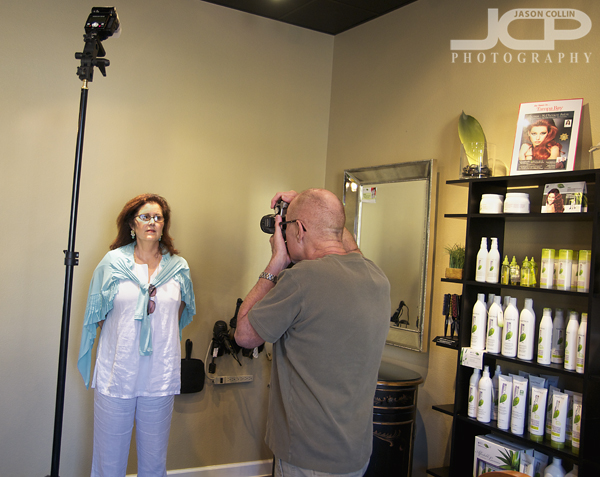
    Practicing off camera flash (strobist) with Jackie as Stuart's model in his Safety Harbor salon

    Stuart was interested in a very specific DSLR photography lesson -- how to take "before & after" headshots of his customers in his salon (website).  This very specific photographic need actually makes the lesson easier for me to teach in a way because the student and I can concentrate on just the settings needed for the type of shot he wants.  Since he has his own salon with consistent lighting, it was just a matter of finding a spot with a clean background and getting our off camera flash settings dialed in.

    Right now Stuart just has a Canon XT with the standard 18-55mm kit lens.  In the photo above I set him up with my Nikon SB-800 Speedlight, light stand and Yongnuo radio remote triggers (which allows a Canon camera to use a Nikon speedlight).  However, we started out just doing natural light, then his built-in pop-up flash, then simulating the speedlight being hotshoe mounted, and then finally true strobist style.  Of course the best results were produced using the strobist (off camera flash) method.  

    For the lesson Stuart's pal Jackie was our willing model.  In addition to teaching Stuart strobist techniques, I also helped him to pose the model (Jackie) for best impact and lighting, as well on how to best frame a shot in the limited shooting space of the salon.  I recommended a tight composition to eliminate the need to later crop the image and to eliminate what I call intruders (like those brushes on the wall) messing up the clean background.

    It was nice to have a lesson in air conditioning and fun to meet Jackie and Stuart.  Once Stuart gets his own speedlight, we will meet again for another lesson.   

  • Reserve your own 1-on-1 DSLR Photography Lesson with Jason today!
  • Learn more about the lessons
  • Browse past lessons with all of my students 
  • DSLR Photography Long Exposure Lesson with Scott on Sunset Beach St. Petersburg

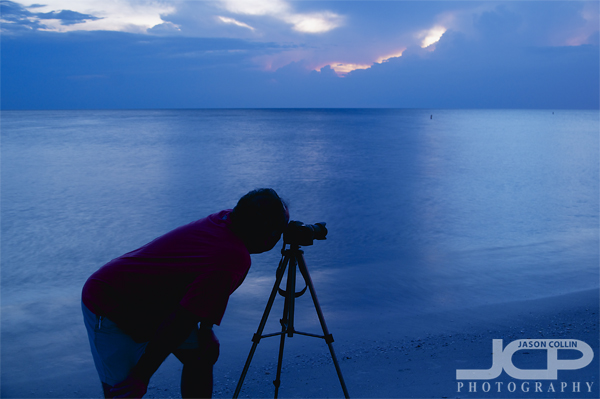
    Practicing long exposure photography - Nikon D300 Tamron 17-50mm @ f/4 ISO 200 2sec tripod mounted with cable releaseNew DSLR Photography student, Scott, is a native of St. Petersburg.  He loves to photograph Florida's great twilight skies after the sun goes down.  He recently bought a Nikon D50 from a friend.  He has photography knowledge from the film days, but wanted to learn how to change the settings (and why) on a DSLR camera.  He was also trying to photograph twilight skies handheld!

    The first thing I had Scott do is get his D50 onto his (headless) tripod.  Then I explained my progression for setting settings on my own camera:  aperture -> ISO -> white balance -> focus mode & points.  I told him to say goodbye to the presets on the D50's exposure dial and that we would only work with aperture priority and manual exposure the rest of the evening.  

    Scott had a great enthusiasm for photography and photography knowledge.  He wisely had a notebook with him to write down the things I was going over with him.  As excited as he was about this preliminary stuff, his mind was about to really be blown . . .

    Scott said he like to shoot well after sunset, and as mentioned before he was not using his tripod for this.  Plus he was not manually controlling the shutter.  So I had him setup his tripod mounted Nikon and compose the shot how he liked, then set his exposure to 10 seconds and put the shutter on the timer to reduce shake (since he had no remote).  He was amazed at how long 10 seconds felt and that it seemed like magic.  You can imagine what happened when we finally did 30 second exposures and even a bulb mode shot of 79 seconds!.

    It felt great to be able to give Scott the tips he needed to be able to make the types of photographs he wanted to.  I look forward to seeing what he comes up with! 

  • Reserve your own 1-on-1 DSLR Photography Lesson with Jason today!
  • Learn more about the lessons
  • Browse past lessons with all of my students