Photography Tips

Photography Tip - It only has to interest you - drumsticks

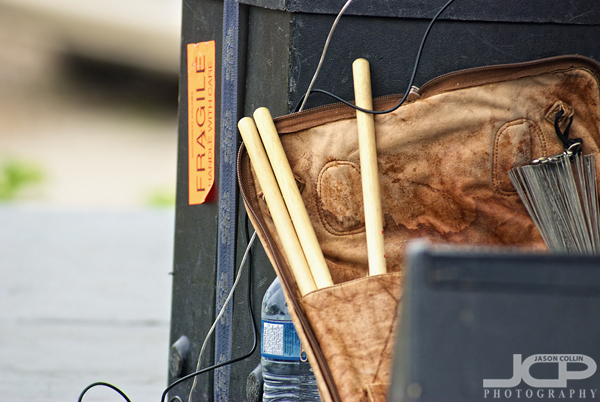
These drumsticks & their case interested me - Nikon D80 Nikkor 80-200mm @ f/4 ISO 400 1/200thI first and foremost make photographs that interest me.  This for the most part even applies when I am shooting for a client as I trust they hired me because they liked my past work and know that I will bring that same perspective to their shoot as well.  I made this drumsticks shot while shooting a Brett Eldredge concert for an event client.  This photograph may have no interest to anyone but me, but that does not come into my thinking at all when I made the image.  I was drawn to the satchel the sticks were sticking out of in particular.  It looked very old and worn and thus must have a great story behind it.  I never talked to the drummer about it, but I wanted to make a photograph of it for my own memory and for me to wonder what might be the origin of the satchel, was it his father's before him, or given to him by a drummer he looked up to?  Those questions interest me, even if I can never get an answer to them.

I included this image in the 240+ I delivered to the client.  It may just be a throwaway image, but for me it will be a reminder of that concert and shooting that job.  

Shooting what interests you first and foremost is what one should really only ever do in one's personal shooting.  I cannot imagine doing otherwise really.  When just going out shooting (not for a client) why would you ever shoot anything that does not interest you?  Likewise, shooting something you think will be interesting to others, but is not interesting to yourself, I cannot imagine the point in doing that and I would also imagine the results of those photographs would be very subpar at best.  

If no one else in the world finds the photograph interesting, but you do, then that is still a successful photograph.  That is my thinking.

Use Negative Space when composing photography tip

Composing with negative space - Nikon D300 Tamron 17-50mm @ f/11 ISO 200 1/400th

 I often tell my DSLR photography students to "fill the frame" when composing shots.  I also recently wrote about how not including the entire motorcycle makes for an image with more impact.  That said, another composition technique follows just the opposite of those and calls for using negative space in the frame to be part of the photograph.  

In the above image instead of filling the frame with the palm tree, or using a rule of thirds type of composition, the palm tree is composed as to look small and isolated allowing the negative space itself to be the main subject of the photograph.  Filling the frame with negative space gives the impression of great expansion, or rather, no end once the eye reaches the edge of the frame.  The viewer's eye continues on past the edges filled in by their own imagination of what goes beyond.  

Post a link to your example of negative space composition in the comments below.

1-on-1 DSLR Photography Lesson in St. Petersburg Canon XTi with Veronica

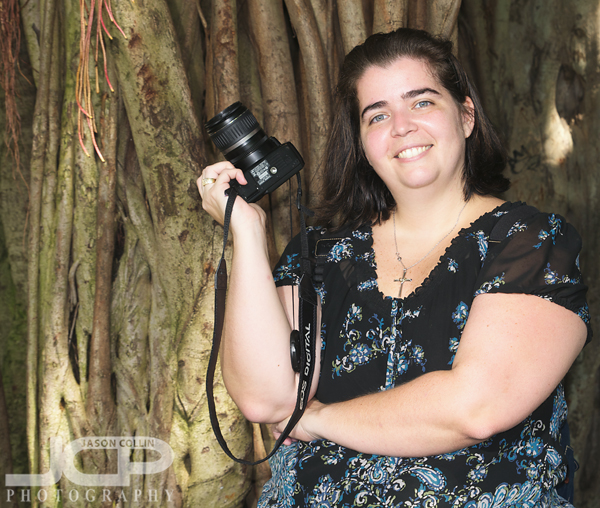
Veronica with her Canon XTi in front of downtown St. Petersburg's banyan treesFor our 1-on-1 DSLR Photography Lesson Veronica came all the way down from Spring Hill, quite a journey down the most unpleasant road in the area, U.S. 19.  Perhaps in reward for that effort we were treated to a beautiful morning in downtown St. Petersburg that was not too hot, with a nice breeze.  

Like many of my photography students, Veronica has had her DSLR for a bit of a long time, but had only ever been using it on auto-mode.  She was familiar with some photography terms from a bit of self-study, but she was hoping our lesson would help her make much better portraits of her children and improve her photography overall in general.  Well, that is exactly what I design the 1-on-1 lessons to do so it was a perfect match in that regard.  

I taught Veronica my (yet to be patented) 4-step process for setting up any given shot, and upon realizing the meter in her Canon XTi was either somehow suffering from some internal problem or just not that good, we almost immediately went into manual mode which produced much better looking exposures.  

We concluded the lesson under the famous banyan trees of downtown St. Petersburg with a little flash portrait practice.  Also, since she only has one lens (18-55mm) at this time and really wanted to be able to make better portraits and get closer to her subjects, I suggested she next invest in a 55-200mm lens or similar to be able to make the shots she needs.  We will meet again later this summer after she practices some more on her own (highly recommended) and perhaps invests in some new gear as well.

1-on-1 DSLR Photography Lesson in St. Petersburg Canon T1i at The Pier with Kristin

Purposefully overexposing practice out at The Pier with Kristin and her Canon T1iIn the two weeks since our first 1-on-1 DSLR Photography Lesson together Kristin has added greatly to the inventory of her camera bag with a very nice new Manfrotto tripod, a 50mm lens and an external flash!  However, our intended topic for our second of four lessons was bird-in-flight shots so none of her new gear applied to that, but since there bird action around The Pier was uncharacteristially quiet yesterday evening we did end up using her tripod to practice some landscape and sunset shots.  

It was a nice breezy walk out to The Pier where I got Kristin setup with her 70-300mm lens for being able to capture bird-in-flight images, which is not easy to do.  Even though, unfortunately, there were not many birds that particular evening, Kristin took a liking to this kind of photography and will practice more on her own near her hometown area of Gulfport which also has a waterfront and a pier.  

This gave us time for me to show her the basics of tripod usage, like lining up the barrel of the lens flush over one of the tripod's legs and which knob on the ballhead allowed for which adjustment.  We could not have had a great contrast going from birds-in-flight requiring very fast camera movement to long exposure shots on a tripod requiring very little physical effort on the part of the photographer.

We covered a good amount of photography topics once again during our 2-hour lesson which I enjoyed a lot and next up will be putting some more of Kristin's new gear to use!

Use a 50mm lens as a macro lens photography tip

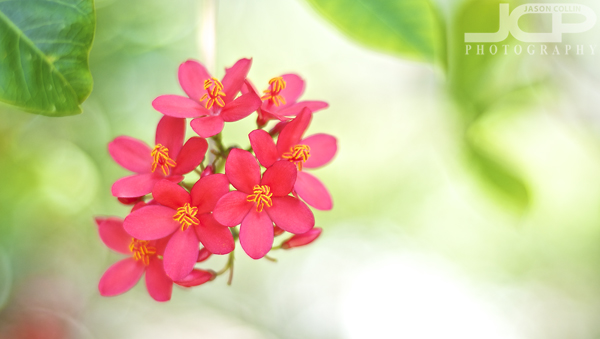
Bokeh created by using a 50mm lens - Nikon D300 Nikkor 50mm @ f/2 ISO 200 1/400th natural lightMacro lenses are expensive.  They are great, but if macro photography is one of many types of photography you like the cost may not be justified, even though macro lenses often can be great for portraits and other things too.  Before you spend $500 or $1,000 or more on a dedicated macro lens, I suggest getting a 50mm lens first (if you do not already have one, which you should!) for about $120 which can be used as a kind of macro lens and see just how much you like macro photography.  If you cannot get enough of it, then investing in a dedicated macro lens would be worth it.  If you are pleased with the results you are getting with the 50mm lens, well then you saved hundreds of dollars and you also get all the other benefits of a 50mm lens.

The flower image above was made with a 50mm f/1.8 lens @ f/2 with no special lighting, just ambient.  Post a link in the comments below to macro images you made with a 50mm lens.

Macro Jewelry Product 1-on-1 DSLR Photography Lesson in St. Petersburg Canon T3 with James

James making a macro shot of a ring in a lightbox during our 1-on-1 photography lessonThis morning I headed over to the BB&T Building in downtown St. Petersburg to meet James in his office for an atypical 1-on-1 DSLR Photography Lesson.  He sells rings and other jewelry and wanted help making the best product shots he could using his Canon T3, lightbox and Canon 60mm macro lens.  He also wanted workflow instruction on how to cleanly remove the ring from the background and place it on a pure white one.

We started off with shooting instruction and the best settings to use and also where to place the lights to give the best look on the ring itself.  Since the lighting and subjects were constants, it did not take long to dial in the best settings.  We took those sample shots we made and opened them in Photoshop where I showed James my Quick Select & Refine Edge technique for putting a subject on a clean white background.  In order to produce the best looking edges, I had to use one extra setting I had not used before in the Refine Edge process, teaching myself something new on the fly as well as James!  In the end we were both very pleased with the results we were able to produce.  One other top tip for Photoshop, if you are having trouble selecting an image, do not crop the image at all, leave as much space between the frame and the object as possible, as this was how we were able to get a more accurate quick select.  I told James many times that Photoshop is alive and has feelings and needs to be coerced sometimes into doing things!

James only had a very short and flimsy tripod to put his Canon T3 on so right during the lesson I helped him pick out a very nice Induro tripod and also a cable release!  It was a fun and different lesson than my usual ones and I enjoyed learning about James' various businesses.

Nikon D40 1-on-1 DSLR Photography Lesson with Kelly in St. Petersburg Florida

Kelly contacted me with a time sensitive need for a 1-on-1 DSLR Photography Lesson so she could use the knowledge for an upcoming shoot.  She has been doing portrait sessions and weddings and wanted help to organize the knowledge she had and get know-how for making consistently sharper images in particular.  Most photographers have no system for setting up a shot, which I think is critically important.  I change my settings in the same progression for each and every shot, every time.  This way I do not miss anything and if a photographer does not have that much experience, it limits the "panic feeling" of hurriedly trying to get a shot that was very different from the one you just took (i.e. indoors to outdoors).  

Just going through the deeper settings on Kelly's Nikon D40 I was able to improve her final image results by 20% even if she instantly forget everything I would soon teach her during our 2-hour lesson.  However, I am not worried about her remembering what we practiced because she took extensive and detailed notes throughout the entire lesson, which I highly recommend.

I am looking forward to seeing Kelly's future portrait and wedding work!